How to Build a Digital Marketing Plan for Small and Mid-Sized Businesses

Photo by Andrew Neel on Unsplash.
A useful digital marketing plan for small and mid-sized businesses connects a business goal to a manageable set of channels, a realistic budget, and a way to measure results. Start with the customers and services you want to grow, fix the path from website visit to inquiry, then choose the channels most likely to reach those customers.
SEO, Google Ads, paid social, and AI visibility each have a role. The right mix depends on whether people already search for your service, how quickly you need leads, and how much your team can execute consistently.
For an Allentown professional services firm, a Lehigh Valley home services company, or a growing regional business, the first question is practical: which marketing investment will help the right person take the next step?
This guide explains how to choose, includes a Punch Garage client example, and ends with a checklist you can use today.
1. Set one measurable business goal
Choose a primary outcome for the next 90 days. “Get more visibility” gives your team little direction. “Generate 20 qualified inquiries per month for our commercial service” gives you something to plan and measure. That is an example target; yours should reflect your starting point and capacity.
Define a qualified lead before spending. For a service business, it might mean an inquiry from someone in your service area, looking for a service you offer, with a suitable project size.
- Business goal: Which service, audience, or location needs growth?
- Conversion: Is the next step a call, consultation, quote request, booking, or purchase?
- Capacity: How many new customers can your team serve?
- Economics: What can you afford to spend to win one customer?
For example, if your business can afford $250 to acquire a customer and closes 20% of qualified leads, the corresponding ceiling is $50 per qualified lead. Include the marketing costs you want that ceiling to cover, and use your own margins and sales data.
2. Match the channel to the job
Use this comparison to choose an initial focus. These are planning considerations, not guaranteed outcomes.
CAPTURE EXISTING DEMAND
They are searching.
Start with focused service pages, SEO, and a Google Ads test.
INTRODUCE YOUR OFFER
They need to discover it.
Test paid social with a clear offer and compelling creative.
HELP BUYERS EVALUATE YOU
They are comparing.
Support SEO and AI visibility with expertise, reviews, and case studies.
| Channel | Best starting use | What it needs | Measure |
|---|---|---|---|
| SEO | Build visibility for services people already search for | Useful service pages, technical access, local relevance, ongoing work | Relevant organic visits, qualified inquiries, sales |
| Google Ads | Test demand and reach people searching now | Ad budget, focused keywords, a strong landing page, conversion tracking | Cost per qualified lead and customer acquisition cost |
| Paid social | Introduce an offer, demonstrate value, or reach a defined audience | Compelling creative, audience fit, a clear offer, follow-up | Qualified leads, bookings, and resulting customers |
| AI visibility | Improve how clearly search and AI tools can discover and describe your business | Accessible content, clear business details, original expertise, credible evidence | Relevant mentions, referrals where available, assisted inquiries |
SEO: build visibility around the services you want to sell
Search engine optimization helps people find your business through unpaid search results. For many small and mid-sized businesses, the most useful starting point is the website’s core service pages.
A local accounting firm needs a clear page about its accounting services, the clients it serves, and how to request a consultation. A general article about accounting cannot do all of that work.
Start by checking whether important pages can be indexed, whether mobile visitors can use them easily, and whether each page answers the questions buyers ask. Add relevant project examples, accurate business information, and clear internal links. Keep your Google Business Profile current if your business is eligible.
Prioritize SEO when: Customers search for your services and you can invest consistently over several months. Track useful inquiries as well as rankings; the goal is to attract potential customers who fit your business.
Google Ads: reach customers searching for help now
Google Search ads can put your offer in front of people actively looking for a service. They are useful when you need to test a specific offer or create opportunities while organic visibility develops.
Start with a focused service and relevant geography. Send visitors to a page that matches the ad, explains the offer, shows proof, and makes contact easy. Review the actual search terms that trigger ads and exclude irrelevant searches.
Set up conversion tracking before judging performance. Calls, completed inquiry forms, and bookings are more useful signals than clicks alone. Then connect inquiries to sales follow-up so you can distinguish a form submission from a qualified opportunity. Google’s guide to Search campaign measurement explains the key conversion metrics.
Prioritize Google Ads when: There is relevant search demand, you can fund a meaningful test, and someone can respond promptly. Estimate likely clicks using current keyword costs before committing your budget.
Paid social: give the right audience a reason to act
Paid social reaches people as they browse platforms such as Facebook, Instagram, and LinkedIn. It can help introduce an unfamiliar service, demonstrate a visual result, promote an event, or bring an offer to a specific professional audience.
Choose the platform based on the customer and offer. A consumer service may suit a short demonstration on Instagram. A specialized B2B service may benefit from messaging for particular business roles on LinkedIn. Validate that fit through testing.
Give each campaign a clear reason to respond: a consultation, useful resource, event, or specific service offer. Test the message and creative, and assess lead quality with the team handling inquiries. Retargeting can also support follow-up where audience size, consent, and platform rules allow.
Prioritize paid social when: Your audience needs to discover or understand the offer before searching for it, and you have the creative and follow-up capacity to support a test.
AI visibility: make your expertise easier to discover and evaluate
AI visibility means understanding whether AI-powered search experiences and assistants mention your business, describe it accurately, or use your content as a source. Different platforms use different systems, so results vary.
Build this work into your SEO and content plan. Explain what you do, who you help, where you work, and why a buyer should trust you. Publish useful answers based on your experience, with real examples and clearly attributed results. Keep important business profiles consistent.
For Google’s generative AI search features, established SEO practices remain foundational. Google’s AI search guidance emphasizes useful original content and technical accessibility. Formatting alone does not secure a citation.
Prioritize AI visibility when: Customers use AI tools to research providers or compare options. Include representative customer questions in your monitoring, and connect the work to relevant service pages and case studies. Explore Punch Garage’s AI visibility services.
3. Prioritize your budget around the biggest constraint
Build a total monthly budget that separates advertising spend from strategy, management, content, design, website work, and software. A $2,000 ad budget and a $2,000 total marketing budget support different plans.
PLAN FOR THE FULL COST
Ad spend, SEO, and useful content
Landing pages, creative, and a clear offer
Tracking, lead qualification, and management
Use these spending bands as illustrative planning scenarios, not Punch Garage pricing or a promise that a particular budget will produce leads.
If your total budget is under $2,500 per month
Keep the scope narrow. Improve the most important service page, verify tracking, maintain your local presence, and choose one acquisition priority. If current click costs leave too little room to test paid advertising, focus on the website and organic foundations first. Include AI visibility improvements in that content work.
If your total budget is $2,500–$6,000 per month
Consider one focused paid channel alongside ongoing SEO and website improvements. A local service business with active search demand might pair Google Ads with better service pages. A business introducing a new offer might test paid social instead. Fund the landing page and follow-up process as part of the campaign.
If your total budget is above $6,000 per month
Expand once you can identify what produces qualified opportunities. Add a second channel, additional creative, or deeper content when the team can execute and measure it. A larger budget still needs clear priorities.
Before approving any paid test, estimate the traffic it can buy. At an illustrative $10 per click, $1,000 buys about 100 clicks. At an illustrative 5% inquiry rate, that produces five inquiries before qualification. Actual costs and rates vary. This simple calculation helps you judge whether the test can support your goal.
Punch Garage case study: Lehigh Valley Counselors
80 leads per month on average
From Google Ads and organic search, measured through phone calls and form submissions.
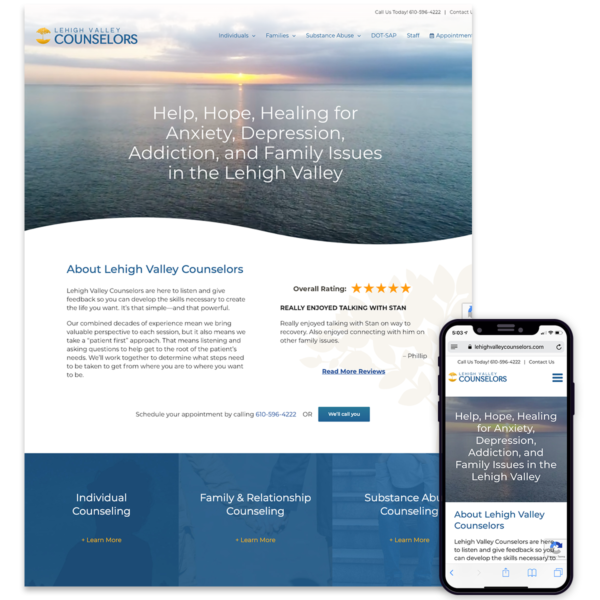
Lehigh Valley Counselors needed a brand and website that reflected its welcoming experience and helped people searching for counseling services take the next step.
Punch Garage helped build the brand, launch the website, and establish search visibility. Our ongoing work includes managing the practice’s Google Ads campaigns.
As reported in our published case study, the practice generates an average of 80 monthly leads from paid and organic search combined. The initial SEO work also helped all 10 targeted keywords reach page one of Google within two months of launch.
The practical lesson is how the pieces work together: a clear offer, a website that encourages contact, organic visibility, and ongoing advertising. These results are specific to this practice. Calls and forms measure inquiries; client acquisition depends on qualification and follow-up.
Read the Lehigh Valley Counselors case study or View our Case Studies.
4. Turn the plan into 90 days of work
01–30
Build the foundation
Baseline · Website · Tracking
31–60
Run a focused test
One priority · Launch · Review
61–90
Improve and decide
Lead quality · Cost · Next steps
Days 1–30: establish the foundation
Document your baseline, choose a primary service and audience, test the inquiry process, and fix the most important website issues. Confirm that calls and forms are measured correctly. Assign an owner to each task.
Days 31–60: launch a focused test
Launch your chosen campaign or publish the highest-priority service content. Keep the offer and destination aligned. Review search terms, lead quality, and sales follow-up regularly. Record what you changed so results have context.
Days 61–90: improve and decide
Compare the results with your baseline and lead-quality criteria. Improve the pages, creative, or targeting that need attention. Expand work that produces suitable opportunities at an acceptable cost. Allow for your sales cycle and the time organic search needs to develop before drawing conclusions from limited data.
Your digital marketing plan checklist
Use this checklist in your next planning meeting. Assign an owner and due date to each unfinished item.
- Write one 90-day business goal and define a qualified lead.
- Choose the priority service, audience, and service area.
- Record current traffic, inquiries, qualified leads, and new customers.
- Set a total budget and separate ad spend from execution costs.
- Choose one primary acquisition channel and explain why it fits.
- Check the main service page on a phone and submit a test inquiry.
- Confirm that calls and forms are tracked without counting duplicates as new leads.
- Add a relevant case study or testimonial near the next step.
- Answer an important buyer question using your own experience.
- Check the accuracy of your business details across key profiles.
- Assign responsibility for responding to and qualifying inquiries.
- Set a weekly campaign check and a monthly business-results review.
In that monthly review, calculate cost per qualified lead and customer acquisition cost. Track organic visits and AI mentions as supporting signals. Check what turns into suitable customers before increasing spend.
Too many channels and no clear marketing plan?
Use a 20-minute call to review your goals, budget priorities, and which channels to explore first.